Via DailyTech.com
Apple last week released a massive security update package for their Mac OS X operating system as well as updates for the QuickTime player bundled with Mac OS X. The update fixes a number of security issues including a number of code execution vulnerabilities that could allow an attacker to compromise Mac OS X and run undesirable programs.
The update also includes fixes for Apples popular Quick Time player that could allow an attacker to use malformed media files launch denial of service attacks or compromise a users system. The update to QuickTime also improves the applications stability.
The Mac OS X update also fixes code execution vulnerabilities in AppKit, ImageIO, BOM, CFNetwork, ClamAV, CoreFoundation, Finder, FTPServer, FlashPlayer, LaunchServices, libcurl, Preview, QuickDraw and QuickTime Streaming Server.
Anyone have a breakdown on the time between fixes in the open source world and when they are fixed in OS X??
ClamAV and several of the other products are open source, and it is well known that vulnerabilities found in open source products are also found in their OS X couterparts.
This fact isn't something that Apple can afford to overlook. When open source products are patched, the details are handed to the bad guys. How long will that vulnerability exist in OS X before it is fixed??
Wednesday, May 17, 2006


When Spammers Hit Back
Wired.com has a great article on the work conducted by Blue Security. However, Blue Security has put down its weapon and left the ring. But those guys can remember that they did make a difference and presented an outside-the-box method of fighting spam.
Perhaps one day, the Can-Spam Act can be used to fight the real spam problem, at this point it is just a sheet of paper in my view. Used against real companies that make mistakes, it isn't stopping PharmaMaster and others like him.
------------------------------
Starting May 2, a spammer known as PharmaMaster used a massive network of zombie computers to flood Blue Security's database servers with fake traffic and hijacked a little-known Cisco Systems router feature known as "blackhole filtering" to block anyone outside Israel from accessing Blue Security's homepage.
Blogging software provider Movable Type's hosted service, TypePad, also fell victim to PharmaMaster's bot network, after Blue Security realized that no one could reach its homepage and posted a message to its users on its old blog. Thirty minutes later, PharmaMaster started an attack that brought down thousands of blogs.
Perhaps one day, the Can-Spam Act can be used to fight the real spam problem, at this point it is just a sheet of paper in my view. Used against real companies that make mistakes, it isn't stopping PharmaMaster and others like him.
------------------------------
Starting May 2, a spammer known as PharmaMaster used a massive network of zombie computers to flood Blue Security's database servers with fake traffic and hijacked a little-known Cisco Systems router feature known as "blackhole filtering" to block anyone outside Israel from accessing Blue Security's homepage.
Blogging software provider Movable Type's hosted service, TypePad, also fell victim to PharmaMaster's bot network, after Blue Security realized that no one could reach its homepage and posted a message to its users on its old blog. Thirty minutes later, PharmaMaster started an attack that brought down thousands of blogs.
Tuesday, May 16, 2006
Myspace Phishing Attacks on the Rise
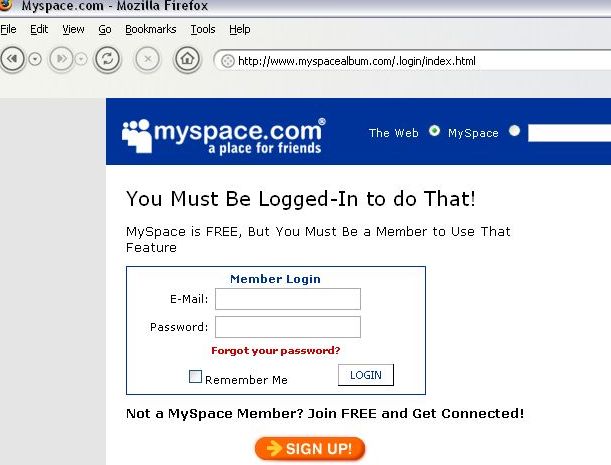
Phishing Attacks against the very popular social networking website are on the rise.
Newest one discovered - http://www[dot]myspacealbum[dot]com/.login/index.html
Abuse Contact @ the Domain has been alerted by e-mail.
This URL was passed around in a bulletin titled "CHECK OUT these old school pictures...". The bulletin was posted by a friend without his knowledge.

Malware or some type of script injection attack might be the bulletin posting vector.
But if they can send bulletins as you without your knowledge, then can install a bank info stealing trojan with a IE vulnerability. The malware or attack script could alter your profile enough that all visitors (your friends) get attacked via drive-by-install.
Within the past week, another bulletin about "party pictures" was used to spread another phishing URL.
Perhaps Myspace should use some of those ad dollars and think about getting a security@myspace email account working ;)
The collected e-mails and passwords could be used to collect more important information. Tons of people use the same password for both for multiple pages.
Lets just hope that most of the younger people don't have paypal accounts ;)
As these social network groups grow, they are now in the crosshairs to become a future attack vector.
Malware distributors can operate hidden behind the cloak of "fun harmless social interaction" and take advantage of client-side vulnerabilities via script injection - Myspace worm ring a bell.
Sun to Open Source Java
Via ComputerWorld -
SAN FRANCISCO -- Sun Microsystems Inc. at its JavaOne conference today announced plans to open source Java, but said before it does so company officials have to be certain the move won't lead to diverging paths in the code.
Very interesting but not totally shocking. Sun already has plans to move Solaris totally into the open source model. OpenSolaris.org was opened and already has working open source OS.
In the end, it will be kinda like the Fedora project before the Fedora Foundation was created =)
Perhaps Sun sees that the open source model is the only way to stay in the fight ;)
SAN FRANCISCO -- Sun Microsystems Inc. at its JavaOne conference today announced plans to open source Java, but said before it does so company officials have to be certain the move won't lead to diverging paths in the code.
Richard Green, Sun's executive vice president of software, made it absolutely clear that Java would be opened source.
Very interesting but not totally shocking. Sun already has plans to move Solaris totally into the open source model. OpenSolaris.org was opened and already has working open source OS.
In the end, it will be kinda like the Fedora project before the Fedora Foundation was created =)
Perhaps Sun sees that the open source model is the only way to stay in the fight ;)
Sunday, May 14, 2006
Fun: Happy Mothers Day
ASCII:
happy mothers day
Morse Code:
.... .- .--. .--. -.-- -- --- - .... . .-. ... -.. .- -.--
Leet Speak:
h4ppy m07h3r5 d4y
Hex Encoded:
68 61 70 70 79 20 6d 6f 74 68 65 72 73 20 64 61 79
Binary Encoded:
01101000 01100001 01110000 01110000 01111001 00100000 01101101 01101111 01110100 01101000 01100101 01110010 01110011 00100000 01100100 01100001 01111001
Octal Encoded:
150141160160171040155157164150145162163040144141171
Base64 Encoded:
aGFwcHkgbW90aGVycyBkYXk=
ROT13 Encoded:
unccl zbguref qnl
DES Encrypted Using the Phase "candy":
8cIWUhWVxn5iGO1OmCTuFjsC9I9eXUuF
happy mothers day
Morse Code:
.... .- .--. .--. -.-- -- --- - .... . .-. ... -.. .- -.--
Leet Speak:
h4ppy m07h3r5 d4y
Hex Encoded:
68 61 70 70 79 20 6d 6f 74 68 65 72 73 20 64 61 79
Binary Encoded:
01101000 01100001 01110000 01110000 01111001 00100000 01101101 01101111 01110100 01101000 01100101 01110010 01110011 00100000 01100100 01100001 01111001
Octal Encoded:
150141160160171040155157164150145162163040144141171
Base64 Encoded:
aGFwcHkgbW90aGVycyBkYXk=
ROT13 Encoded:
unccl zbguref qnl
DES Encrypted Using the Phase "candy":
8cIWUhWVxn5iGO1OmCTuFjsC9I9eXUuF
Politicians Target Social Sites For Restrictions
Via /. -
"Politicians are looking for reasons to convince citizens to vote in November, and polls say suburban parents are worried about the internet. Wednesday top House Republicans announced a bill to make 'social' Web sites unreachable from schools and libraries. The bill is intended to go after MySpace, but the actual text of the legislation covers sites that let users 'create profiles' and have a 'forum' for conversations -- which would include Slashdot and many blog sites. House Speaker Dennis Hastert claims it's necessary to stop 'dangerous predators' out here on the Interweb."
I don't like the sound of that at all. Schools should have the power to block whatever you want to protect the student and their network, but this bill sounds way too wide. CNET allows a forum to talk about articles? Will that be blocked? Google has groups, will that make all of Google blocked? Slashdot itself might even be blocked.
"Politicians are looking for reasons to convince citizens to vote in November, and polls say suburban parents are worried about the internet. Wednesday top House Republicans announced a bill to make 'social' Web sites unreachable from schools and libraries. The bill is intended to go after MySpace, but the actual text of the legislation covers sites that let users 'create profiles' and have a 'forum' for conversations -- which would include Slashdot and many blog sites. House Speaker Dennis Hastert claims it's necessary to stop 'dangerous predators' out here on the Interweb."
I don't like the sound of that at all. Schools should have the power to block whatever you want to protect the student and their network, but this bill sounds way too wide. CNET allows a forum to talk about articles? Will that be blocked? Google has groups, will that make all of Google blocked? Slashdot itself might even be blocked.
IMHO, this will not help anything anyways. Students of this generation are very tech smart, perhaps smarter than the people that are passing the laws. Most students can bypass school proxy systems already very easily. There are whole teen groups and sites dedicated to sharing bypass information. So what is this going to do?? Really?
System Virginity Verifier (SVV) Code Released
On March 12th, Joanna Rutkowska released the source code for SVV 2.3.
Dave Aitel stated that he would work the code into CANVAS - so that each new node could be checked for previous pwners =) Damn cool.
BTW, Happy 30th B-day Dave.
Dave Aitel stated that he would work the code into CANVAS - so that each new node could be checked for previous pwners =) Damn cool.
BTW, Happy 30th B-day Dave.
Saturday, May 13, 2006
Fun: Today's Acquisitions

(Left to Right, Top to Bottom)
1. Smacks - Beats and Things Vol. 1
2. Def Jam South - Ludacris Single
3. Same as #2
4. The Acappellas - Biggie Smalls & 2PAC
5. Sqratchers Delight Vol. 2
6. Cartoon Breaks (Double Vinyl)
7. Dave Chappelle's Block Party
8. DJ Shadow - In Tune and On Time
Inside Threat - Designer Virus?
Security experts have always stressed the pont of the "insider attacker". Attacker can come from anywhere, even your own staff.
I found this article over at CRN.com.au about a pretty silly virus, but there are notes in the article that point to it being a real life digital designer virus. Even if it was some kid working at BestBuy....
Interesting stuff.
I found this article over at CRN.com.au about a pretty silly virus, but there are notes in the article that point to it being a real life digital designer virus. Even if it was some kid working at BestBuy....
Interesting stuff.
Automated Malware Classification
Very interesting article over at eWeek.com.
The company unveiled its plans at the EICAR (European Institute for Computer Anti-Virus Research) conference in Hamburg, Germany, proposing the use of distance measure and machine learning technologies to come up with automatic classification of viruses, Trojans, spyware, rootkits and other malicious software programs.
A research paper presented by Microsoft's lead anti-virus researcher, Tony Lee, described the existing process of manual human malware analysis as "inefficient and inadequate" and suggested an ambitious method that combines runtime behavior analysis, static binary analysis and adaptable algorithms to automate classification.
See the full Microsoft white paper in .DOC form.
The company unveiled its plans at the EICAR (European Institute for Computer Anti-Virus Research) conference in Hamburg, Germany, proposing the use of distance measure and machine learning technologies to come up with automatic classification of viruses, Trojans, spyware, rootkits and other malicious software programs.
A research paper presented by Microsoft's lead anti-virus researcher, Tony Lee, described the existing process of manual human malware analysis as "inefficient and inadequate" and suggested an ambitious method that combines runtime behavior analysis, static binary analysis and adaptable algorithms to automate classification.
See the full Microsoft white paper in .DOC form.
Thursday, May 11, 2006
Tools of the Trade - Update
1) Nmap 4.03 is out - I have been very impressed with all the changes made since 3.99. Great stuff, keep them coming.
They have also released a Windows setup bundle. It takes care of the Winpcap install, the registry changes and everything for you. Sig DB has increased as well. Go get it.
2) THC has updated Hydra to 5.3 - They added a HTTP form module and NTLM support for pop3, imap, smtp-auth and http-proxy. Very cool.
Brutus has a pretty advanced form module that learns the parameters from the page itself, but it lacks a directory input field for HTTP auth attacks - which is a very nice feature of Hydra.
3) Ethereal 0.99.0 was released out of development. Too many fixes to count. Check out the changelog.
They have also released a Windows setup bundle. It takes care of the Winpcap install, the registry changes and everything for you. Sig DB has increased as well. Go get it.
2) THC has updated Hydra to 5.3 - They added a HTTP form module and NTLM support for pop3, imap, smtp-auth and http-proxy. Very cool.
Brutus has a pretty advanced form module that learns the parameters from the page itself, but it lacks a directory input field for HTTP auth attacks - which is a very nice feature of Hydra.
3) Ethereal 0.99.0 was released out of development. Too many fixes to count. Check out the changelog.
Tuesday, May 9, 2006
Network Neutrality - Money Can't Buy Love
SBC, AT&T and others attempt to use their money to make sure "network neutrality" is not put into law.
Annalee Newitz said it better than I could myself in her recent column.
Although never written into US law, this principle holds that nobody's Internet traffic should be privileged over anybody else's -- to do so would be like letting an electricity company cut a deal with GE so that only GE appliances got good current. As it turns out, the neutral network provides an excellent platform for business models that cluster at the ends of the wires: Everything from Google and eBay to ISPs and music-downloading companies are based on the idea that money is made by shooting good stuff over the wires, not by making some wires better at getting good stuff.
Well said indeed. Lets show them that no amount of money can take the internet away from us.
Annalee Newitz said it better than I could myself in her recent column.
Although never written into US law, this principle holds that nobody's Internet traffic should be privileged over anybody else's -- to do so would be like letting an electricity company cut a deal with GE so that only GE appliances got good current. As it turns out, the neutral network provides an excellent platform for business models that cluster at the ends of the wires: Everything from Google and eBay to ISPs and music-downloading companies are based on the idea that money is made by shooting good stuff over the wires, not by making some wires better at getting good stuff.
Well said indeed. Lets show them that no amount of money can take the internet away from us.
Ethics, Hacking and Religion
http://www.informit.com/guides/content.asp?g=security&seqNum=191&rl=1
This hits upon the idea that I talk about once in a while.
Morally right does not always equal legally right; Morally wrong does not always equal legally wrong.
This is the truth that is created by applying black&white rules to a very grey world.
This article brings up a very good view that I haven't seen talked about before now. Very interesting.
I like this quote from Johnny Long - "I felt like God wasn't on the Internet."
Personally I feel we fall into the Yin/Yang world. The world of balance. But I won't go into my balance speech now. lol
This hits upon the idea that I talk about once in a while.
Morally right does not always equal legally right; Morally wrong does not always equal legally wrong.
This is the truth that is created by applying black&white rules to a very grey world.
This article brings up a very good view that I haven't seen talked about before now. Very interesting.
I like this quote from Johnny Long - "I felt like God wasn't on the Internet."
Personally I feel we fall into the Yin/Yang world. The world of balance. But I won't go into my balance speech now. lol
Monday, May 8, 2006
Geek vs Nerds
I don't know who is running Wikipedia....but they need to cleanup those articles.
Pundits and observers dispute the relationship of the terms nerd and geek to one another. Some view the geek as a less technically skilled nerd. Some factions maintain that "nerds" have both technical skills and social competence, whereas geeks display technical skills while socially incompetent; others hold an exactly reversed view, with geek serving as the socially competent counterpart of the socially incompetent nerd, and call themselves geeks with pride (compare Geekcorps, an organization that sends people with technical skills to developing countries to assist in computer infrastructure development). Another view is that "geeks" lack both social competency and technical skills. Arguably, a nerd is a more self-controlled sort of person, while a geek can be something of a loose cannon--or at least more awkward in an obstructive way than a nerd.
Everyone knows that geeks are way cooler than nerds....come on!
Pundits and observers dispute the relationship of the terms nerd and geek to one another. Some view the geek as a less technically skilled nerd. Some factions maintain that "nerds" have both technical skills and social competence, whereas geeks display technical skills while socially incompetent; others hold an exactly reversed view, with geek serving as the socially competent counterpart of the socially incompetent nerd, and call themselves geeks with pride (compare Geekcorps, an organization that sends people with technical skills to developing countries to assist in computer infrastructure development). Another view is that "geeks" lack both social competency and technical skills. Arguably, a nerd is a more self-controlled sort of person, while a geek can be something of a loose cannon--or at least more awkward in an obstructive way than a nerd.
Everyone knows that geeks are way cooler than nerds....come on!
Vulnerability Disclosure - Moving Toward the Event Horizon
If you have been reading this blog or other security new related sites, you might have picked up on a growing and disturbing new trend. Vulnerabilities are moving back underground - redshifting toward the information event horizon.
Why is this happening? Lets look at several points then will help paint scene:
1) More and More independent security researchers are getting into legal trouble
I won't sit here and defend people that break the law to show that a piece of software is vulnerable, but where is the line? What is breaking the law and what is not? Security researchers are normal people and like normal people, some are seen socially as good (whitehats) and some are seen socially as bad (blackhats).
Abraham Lincoln once said,
"Discourage litigation. Persuade your neighbors to compromise whenever you can. As a peacemaker the lawyer has superior opportunity of being a good man. There will still be business enough.”
2) It is easier to catch the bass, than the shark - The real evil people in the world are very hard to catch. They are smart, silent and very well organized.
Example 1 -
Why is this happening? Lets look at several points then will help paint scene:
1) More and More independent security researchers are getting into legal trouble
I won't sit here and defend people that break the law to show that a piece of software is vulnerable, but where is the line? What is breaking the law and what is not? Security researchers are normal people and like normal people, some are seen socially as good (whitehats) and some are seen socially as bad (blackhats).
Abraham Lincoln once said,
"Discourage litigation. Persuade your neighbors to compromise whenever you can. As a peacemaker the lawyer has superior opportunity of being a good man. There will still be business enough.”
2) It is easier to catch the bass, than the shark - The real evil people in the world are very hard to catch. They are smart, silent and very well organized.
Example 1 -
- Caught - Eric McCarty was arrested after indirectly reporting a vulnerability in a USC student database. He conducted the "attack" from his house and used minimal effort to "cloak" himself. He didn't sell the information to Russian or to a carding crew.
- Not Caught - For two weeks, some people "in Asia" who have been illegally accessing information on 200,000 people at the University of Texas. What are they doing with it? Who knows? Will they be caught? Very unlikely.
Example 2 -
- Caught - William Genovese A.K.A. illwill turned himself in for selling Windows source code for $40. Let’s remember, that the source code was already on P2P and anyone could download it at that point. He did break the law by selling it, no contest with that...but he didn't steal it. It is clear that his punishment was based on past events.
- Not Caught - The person that really stole the code. I guess Microsoft wasn't on the FD security list in 2004. Where are these guys? Microsoft isn't after the real people? It is funny how they fail to note that illwill didn't sell the code when they talk about the arrest in the press. SecurityFocus is one of the few articles that showed the other side.
3) Money moves the world - Even if independent researchers do find problems in Microsoft products, what do they get? They could just pass the vulnerability information on to a third-party and perhaps get a little money out of the deal. What is wrong with that? At least Mozilla gives something back to researchers that report security problems.
4) Big Vendors are hiding vulnerability information - Apple and Microsoft fix more vulnerabilities than are commonly known. They secretly fix security problems in patches and never tell you. But once the patches are released, the bad guys know about these unreported security issues. IDS are slow to catch these issues, because of the reverse engineering time needed to provide protection.
In the end, this all adds up to the public being exposed to less and less vulnerability information.
Sunday, May 7, 2006
Pfizer accused of testing drug on children
Via TheAge.com.au -
A panel of Nigerian medical experts has concluded that the world's largest pharmaceutical company, Pfizer, violated international law by testing an unapproved drug on children with brain infections at a field hospital.
Real Life "Constant Gardener" anyone?
A panel of Nigerian medical experts has concluded that the world's largest pharmaceutical company, Pfizer, violated international law by testing an unapproved drug on children with brain infections at a field hospital.
Real Life "Constant Gardener" anyone?
CCTV Planning Documentary on Fall of America
Just found this during some blog surfing...not sure how much truth is behind it, but interesting none the less.
Via the China Confidential Blog -
A China Central Television (CCTV) unit is developing an epic, fall-of-Rome-flavored documentary TV series around the theme of America in decline.
Unlike the crude state-sponsored videos that glorified the September 11 terrorist attacks as a humiliating strike against an arrogant superpower, the planned multipart production promises to be a slick dissection of American economic and military might.
Production notes for the CCTV series, which is tentatively scheduled to air in 2007, are said to provide a revealing glimpse of how certain government officials see the US--namely, as a dying hegemon. The Chinese view is that a number of factors, including "structural" economic problems and imperial overstretch, are combining to end US global supremacy.
In an effort to support and promote this point of view, the CCTV documentary plans to cover all the bases, to use an old American expression borrowed from baseball.
For example, the producers plan to devote at least one episode to the US immigration crisis and attempt to draw historical parallels between a commonly perceived cause of the fall of ancient Rome--unchecked immigration and invasions--and the flood of illegal immigrants pouring into the United States from Mexico and Latin America.
In an ironic twist, the segments on the US economy will supposedly highlight the gloom-and-doom opinions of some smart, successful citizens--fund managers, investment bankers, and analysts--who argue that the country has entered a long period of decline, an economic twilight of sorts, from which no escape is realistically possible. The talking heads of finance are expected to make the case for aggressively investing in emerging markets, especially the so-called BRIC countries (Brazil, Russia, India, China) that are destined to dominate the global economy by 2050, according to an increasingly fashionable Wall Street concept. The CCTV documentary intends to contrast the US financial community's seemingly boundless enthusiasm for investing in China and other emerging markets with an apparently deepening disinterest in domestic investments (except for some stocks, prime property deals and a relative handful of healthcare and high-technology ventures).
The segments on US military power are likely to play up the hoary Mao-era "paper tiger" propaganda line, but with much more finesse than the above-mentioned anti-American videos. Highlighting mistakes made by the Pentagon in Afghanistan and Iraq, the production is expected to make the point that despite its awesome destructive power and global reach, the US military is increasingly overextended and incapable of swift, decisive action around the world. Besides, the documentary is expected to argue, the Iraq experience shows that the American people have lost their taste for foreign intervention and prolonged overseas conflict.
Translation: the US will be in no position to stop China if/when the time comes for it to invade and conquer Taiwan.
Via the China Confidential Blog -
A China Central Television (CCTV) unit is developing an epic, fall-of-Rome-flavored documentary TV series around the theme of America in decline.
Unlike the crude state-sponsored videos that glorified the September 11 terrorist attacks as a humiliating strike against an arrogant superpower, the planned multipart production promises to be a slick dissection of American economic and military might.
Production notes for the CCTV series, which is tentatively scheduled to air in 2007, are said to provide a revealing glimpse of how certain government officials see the US--namely, as a dying hegemon. The Chinese view is that a number of factors, including "structural" economic problems and imperial overstretch, are combining to end US global supremacy.
In an effort to support and promote this point of view, the CCTV documentary plans to cover all the bases, to use an old American expression borrowed from baseball.
For example, the producers plan to devote at least one episode to the US immigration crisis and attempt to draw historical parallels between a commonly perceived cause of the fall of ancient Rome--unchecked immigration and invasions--and the flood of illegal immigrants pouring into the United States from Mexico and Latin America.
In an ironic twist, the segments on the US economy will supposedly highlight the gloom-and-doom opinions of some smart, successful citizens--fund managers, investment bankers, and analysts--who argue that the country has entered a long period of decline, an economic twilight of sorts, from which no escape is realistically possible. The talking heads of finance are expected to make the case for aggressively investing in emerging markets, especially the so-called BRIC countries (Brazil, Russia, India, China) that are destined to dominate the global economy by 2050, according to an increasingly fashionable Wall Street concept. The CCTV documentary intends to contrast the US financial community's seemingly boundless enthusiasm for investing in China and other emerging markets with an apparently deepening disinterest in domestic investments (except for some stocks, prime property deals and a relative handful of healthcare and high-technology ventures).
The segments on US military power are likely to play up the hoary Mao-era "paper tiger" propaganda line, but with much more finesse than the above-mentioned anti-American videos. Highlighting mistakes made by the Pentagon in Afghanistan and Iraq, the production is expected to make the point that despite its awesome destructive power and global reach, the US military is increasingly overextended and incapable of swift, decisive action around the world. Besides, the documentary is expected to argue, the Iraq experience shows that the American people have lost their taste for foreign intervention and prolonged overseas conflict.
Translation: the US will be in no position to stop China if/when the time comes for it to invade and conquer Taiwan.
Friday, May 5, 2006
Science: Ensign, Engage the Cloak!!
Is light a wave or particles? Depends on how you test it and who you ask, I guess. I like to think it is both.
Did you ever play with a tuning fork when you were little? You hit it against the table and then hold it up to a wine glass....the wine glass would match the tuning fork. Pretty cool.
What if we made a light tuning fork? Read on...
Did you ever play with a tuning fork when you were little? You hit it against the table and then hold it up to a wine glass....the wine glass would match the tuning fork. Pretty cool.
What if we made a light tuning fork? Read on...
Thursday, May 4, 2006
Gone in 20 Minutes: Using Laptops to Steal Cars
Via Leftlane Perspective -
High-tech thieves are becoming increasingly savvy when it comes to stealing automobiles equipped with keyless entry and ignition systems. While many computer-based security systems on automobiles require some type of key — mechanical or otherwise — to start the engine, so-called ‘keyless’ setups require only the presence of a key fob to start the engine.
The expert gang suspected of stealing two of David Beckham’s BMW X5 SUVs in the last six months did so by using software programs on a laptop to wirelessly break into the car’s computer, open the doors, and start the engine.
I guess this shouldn't surprise me. As software moves more and more into other parts of our lives, we will see things get hacked that were once only in the hardware hacking world.
High-tech thieves are becoming increasingly savvy when it comes to stealing automobiles equipped with keyless entry and ignition systems. While many computer-based security systems on automobiles require some type of key — mechanical or otherwise — to start the engine, so-called ‘keyless’ setups require only the presence of a key fob to start the engine.
The expert gang suspected of stealing two of David Beckham’s BMW X5 SUVs in the last six months did so by using software programs on a laptop to wirelessly break into the car’s computer, open the doors, and start the engine.
I guess this shouldn't surprise me. As software moves more and more into other parts of our lives, we will see things get hacked that were once only in the hardware hacking world.
Tuesday, May 2, 2006
Water in my Pocket - Nanoelectronics
PHILADELPHIA -- Excessive moisture can typically wreak havoc on electronic devices, but now researchers have demonstrated that a little water can help create ultra-dense storage systems for computers and electronics.
A team of experimentalists and theorists at the University of Pennsylvania, Drexel University and Harvard University has proposed a new and surprisingly effective means of stabilizing and controlling ferroelectricity in nanostructures: terminating their surfaces with fragments of water. Ferroelectrics are technologically important "smart" materials for many applications because they have local dipoles, which can switch up and down to encode and store information. The team's work is reported in the April issue of Nano Letters.
A team of experimentalists and theorists at the University of Pennsylvania, Drexel University and Harvard University has proposed a new and surprisingly effective means of stabilizing and controlling ferroelectricity in nanostructures: terminating their surfaces with fragments of water. Ferroelectrics are technologically important "smart" materials for many applications because they have local dipoles, which can switch up and down to encode and store information. The team's work is reported in the April issue of Nano Letters.
Wow that is pretty cool, so when can I get my water filled NanoUSB??
Subscribe to:
Posts (Atom)